See which of the factors in this article are holding your face back.
Start my face analysisIs Beauty Sleep Real? What Studies Show About Sleep and Your Face
Sleep changes how your face reads to strangers, though less dramatically than the internet claims, and its biggest effect on your looks may run through your appetite.
- Updated October 6, 2026
- 9 min read
- GodModeLooks editorial team
The evidence
- The claim
- That short sleep makes your face look less attractive to other people. The positive studies are small and mostly from one lab, and that lab's own larger randomized trial found no objective change after one night without sleep.
- Emerging evidence
- Small, early, uncontrolled, single-lab or animal studies. Interesting and plausible, not settled. We say so every time. How we grade evidence
Sleep is worth protecting for your looks, but not because one bad night ruins your face. The honest case is steady 7-plus-hour nights, less alcohol before bed, and the appetite effect, which is where the strongest trial evidence sits.
Key takeaways
- 01In small experiments, strangers rated sleep-deprived faces as looking less healthy and more tired, but the drop in attractiveness was tiny, and one lost night left no objective trace in a larger randomized trial.
- 02The American Academy of Sleep Medicine recommends 7 or more hours a night for adults, and extending short sleep by about an hour cut daily intake by about 270 calories in a randomized trial.
- 03Even about two drinks measurably reduce REM sleep. If you snore loudly or wake exhausted, see a doctor, because only a sleep test can diagnose sleep apnea.
In this article
You already know what a bad night looks like in the mirror. Heavy eyelids. Darker circles. A face that seems a shade grayer than yesterday.
So the idea of beauty sleep feels obvious. But "obvious" is exactly where the internet starts exaggerating: one bad night wrecks your face, short sleep crushes your testosterone, people will avoid you. The research is more interesting than that, and more honest. Sleep does change how your face reads to strangers, just less than you have been told, and its biggest effect on your looks may not show in your face at all.
What strangers see in a tired face
The best-known experiment was published in the BMJ in 2010. Researchers photographed 23 adults twice: once after a normal night, and once after 31 hours without sleep. Then 65 strangers rated the photos on a 100-point scale.[1]
The sleep-deprived faces were rated:
- Less healthy, 63 versus 68.
- More tired, 53 versus 44.
- Very slightly less attractive, 38 versus 40.
All three differences were statistically significant. But look at the size of them. Health and tiredness moved clearly. Attractiveness moved by two points out of a hundred.
In a BMJ experiment, strangers rated sleep-deprived people as looking less healthy and more tired. Moderate evidence The attractiveness effect was real but tiny. Weak or contested
What this means for you: sleep loss shows up first as "tired" and "unwell", not as "unattractive". That is still worth avoiding, but it is not a disaster.
The cues people read as tired
A follow-up study looked at exactly what changes. Ten people were photographed after a 5-hour night followed by 31 hours awake, and 40 raters scored specific features.[2]
The sleep-deprived faces showed:
- more hanging eyelids, and redder, more swollen eyes
- darker circles under the eyes and paler skin
- more fine lines and droopier corners of the mouth
- and they looked sadder overall
The effects were modest, between 3 and 15 points on a 100-point scale, and this was a tiny study. The cues people read as tired are droopy eyelids, under-eye darkness, paler skin and mouth corners. Emerging evidence

What this means for you: these are the same features that light, grooming and expression also change. Sleep may help them; it does not cure dark circles or wrinkles.
Two short nights, and one honest correction
The same research group then asked a social question. Twenty-five people were photographed after two nights of 4 hours' sleep and after normal sleep, and 122 raters judged them on 1-to-7 scales.[3]
After the short nights, raters were slightly less willing to socialize with the same person, by 0.15 points from a starting score of 3.79. Rated attractiveness fell by 0.09 and rated health by 0.11. Trustworthiness did not change.
So after two nights of 4-hour sleep, strangers were measurably, if slightly, less keen to spend time with the same person. Emerging evidence
Now the correction, and it comes from the same lab. In a randomized trial of 181 people, one night of total sleep deprivation produced no difference in objectively measured skin color, eye openness, mouth curvature or darkness around the eyes, and no difference in rated health or paleness.[4]
What this means for you: chronic short sleep may shade how others see you. A single late night almost certainly does not.
Why the beauty-sleep evidence is thinner than it looks
It is worth pausing on the quality of this research, because it explains why we grade the headline claim as emerging rather than strong.
- The samples are small. The studies above photographed 23, 10 and 25 people. A handful of faces cannot tell you how much sleep changes the average face, let alone yours.
- Most of it comes from one group. The positive findings largely trace to researchers at the Karolinska Institute. That is not a criticism of their work, but a finding is only as solid as its replications, and independent replications are scarce.
- The deprivation was extreme. Thirty-one hours awake is not a normal bad night. Results under laboratory sleep loss do not translate neatly to an ordinary short night.
- The best study was null. When the same lab ran a randomized trial with 181 people and objective measurements, one lost night left no measurable trace.[4]
None of this means sleep does not matter for how you look. It means the face-specific evidence is early, and the strongest reasons to sleep well lie elsewhere: the guideline, your appetite, your energy.
What this means for you: be skeptical of any confident number about how much sleep changes a face. Nobody has measured it well enough to give one.
How much sleep you actually need
Forget looks-specific sleep targets. The guidance that matters is the one sleep scientists agree on.
A 15-expert panel convened by the American Academy of Sleep Medicine and the Sleep Research Society recommends 7 or more hours of sleep a night, regularly, for adults.[5] Strong evidence Sleeping under 7 hours is associated with weight gain, diabetes, high blood pressure, heart disease, depression, impaired immunity and performance, and accidents. Those links are mostly observational, so they are associations rather than proof that short sleep caused each one.
What this means for you: 7-plus hours is the target. Not as a beauty trick, but as the baseline everything else builds on.
The biggest effect may be on your appetite
Here is the finding that should change how you think about sleep and looks, because it is where the strongest trial evidence sits.
In a randomized trial, 80 overweight adults aged 21 to 40 who habitually slept under 6.5 hours were split into two groups. One group got a single sleep-hygiene session and slept about 1.2 hours more a night as a result. The other carried on as before.[6]
Over two weeks, the sleep-extension group ate about 270 fewer calories a day than the control group, measured with doubly labeled water, and they lost weight compared with controls. Nobody was put on a diet.
In a randomized trial, adding about an hour of sleep cut daily intake by about 270 calories, with no diet. Moderate evidence
Why might that happen? A small randomized crossover study of 12 men points to one possible reason. After short sleep, the fullness hormone leptin fell by 18%, the hunger hormone ghrelin rose by 28%, hunger rose by 24%, and appetite for calorie-dense, high-carbohydrate food rose by 33 to 45%.[7] Short sleep shifts the hormones that control hunger. Moderate evidence

What this means for you: if a leaner face is your goal, sleep is not a side issue. Research links a leaner-looking face to higher ratings of health and attractiveness, as our article on face fat explains, and in a trial sleep was one of the levers on how much people ate.
Testosterone: what the evidence really shows
Sleep and testosterone gets a lot of attention in looksmaxxing, usually with the word "crushes" attached. The evidence is more cautious.
In a small JAMA study, 10 young men averaging 24 years old spent 8 nights sleeping under 5 hours. Their daytime testosterone fell by 10 to 15%, lowest between 2 and 10 pm.[8]
But a 2021 meta-analysis of 18 studies and 252 men found that partial sleep deprivation had no significant effect on testosterone. Total deprivation, 24 hours or more without sleep, did reduce it.[9]
In a JAMA study, a week of 5-hour nights cut young men's daytime testosterone 10 to 15%. Larger reviews find the clearest effect from losing a whole night. Emerging evidence
What this means for you: sleep well because it is good for you, not because it is a testosterone booster. If you are worried about your hormones, that is a conversation for a doctor.
Alcohol, skin and what sleep does not fix
Alcohol cuts the sleep you need
A nightcap feels like it helps you sleep. In a meta-analysis of 27 studies, it mostly did not. About two drinks delayed and reduced REM sleep, and the effect got worse with each extra drink. Falling asleep faster only happened at around five drinks.[10] Strong evidence
A real-world study of 4,098 people who tracked their heart rate variability found that recovery during sleep fell by 9, 24 and 39 percentage points after low, moderate and high amounts of alcohol.[11] Moderate evidence
What this means for you: if you are protecting your sleep, the drinks before bed are part of the picture. For what alcohol does to skin directly, see our skin article.
Skin and sleep: the weakest link
You will often read that sleep repairs your skin overnight. The evidence for that is thin.
One study of 60 white women aged 30 to 49 found that poor sleepers had higher scores for signs of intrinsic skin aging, and good sleepers had 30% better recovery of the skin barrier at 72 hours.[12] But it was cross-sectional, it was commissioned by Estée Lauder, and it included a single ethnic group.
One small study linked chronic poor sleep with slower skin barrier recovery. Weak or contested That is as far as it goes. It is not evidence that sleep reverses aging or prevents wrinkles.
What this means for you: if skin is your priority, sunscreen has far stronger evidence than sleep. Start with what the trials show about skin.
When tiredness is more than a short night
Sometimes the problem is not how long you sleep but how well you breathe while you do it. Obstructive sleep apnea is common, and it is linked to measurable drops in focus and mental sharpness. In a meta-analysis of 1,010 people with sleep apnea and 551 controls, executive function deficits were large, and treatment partly reversed them.[13] Moderate evidence
Treating sleep apnea also improved mood in a meta-analysis of 19 CPAP trials, much more so in people who were depressed at the start.[14]
And there is a small appearance finding. In a study of 20 adults with sleep apnea, strangers rated photos taken after at least two months of consistent CPAP as looking more alert, more youthful and more attractive, with less facial puffiness and redness.[15] Emerging evidence It was small, uncontrolled and single-center, and it says nothing about people without sleep apnea.
What this means for you: if your tiredness does not lift with more time in bed, it is worth a doctor's visit. For the airway side of this, read mouth breathing and face shape, and for the tongue training that trials support, read our mewing article.
The honest beauty-sleep plan
Beauty sleep is real, just smaller and slower than the hype:
- Aim for 7-plus hours, regularly. That is the guideline, and the baseline for everything else.
- Do not panic over one bad night. The best trial found no objective change in the face.
- Watch the drinks before bed. Even about two cut REM sleep.
- Think appetite, not just eyelids. The strongest trial evidence links extra sleep to eating less, and a leaner-looking face is rated healthier and more attractive.
- Get persistent tiredness checked. Snoring and daytime sleepiness are a reason to see a doctor.
Turn the research into a plan
Reading is the easy part. The quiz and scan show which of these factors matter for your face, and in what order to work on them.
01
Answer the questions
Your goals, your routine, your skin, hair, body and style, and how you feel walking into a room. Tap answers only — nothing to type.
02
Take two photos
One front, one side, in even light. You see exactly what you are agreeing to before the camera opens, and you can skip the scan entirely.
03
Get your report and plan
Your scores, what is working for you, what is holding you back, and a plan ordered by the priorities you chose.
Frequently asked questions
Does one bad night ruin your face?
The evidence says no. In a randomized trial of 181 people, one night of total sleep deprivation made no difference to objectively measured skin color, eye openness, mouth curvature or darkness around the eyes.
How much sleep do I need for my looks?
There is no looks-specific number. The American Academy of Sleep Medicine recommends 7 or more hours a night, regularly, for adults, and that is the sensible target.
Does sleep affect weight?
Trials suggest it does. In a randomized trial of overweight adults who slept under 6.5 hours, adding about 1.2 hours of sleep a night cut daily calorie intake by about 270 calories, with no diet.
Does short sleep lower testosterone?
A small study found a week of 5-hour nights cut young men's daytime testosterone by 10 to 15%, but a meta-analysis found no significant effect from partial sleep loss. The clearest effect came from losing a whole night or more.
References
- 01Axelsson J et al. (2010) BMJ 341:c6614. doi.org ↩
- 02Sundelin T et al. (2013) Sleep 36(9):1355–60. doi.org ↩
- 03Sundelin T et al. (2017) R Soc Open Sci 4:160918. doi.org ↩
- 04Holding BC et al. (2019) J Sleep Res. doi.org ↩
- 05Watson NF et al. (2015) Sleep 38(6):843–4. doi.org ↩
- 06Tasali E et al. (2022) JAMA Intern Med 182(4):365–74. doi.org ↩
- 07Spiegel K et al. (2004) Ann Intern Med 141(11):846–50. doi.org ↩
- 08Leproult R, Van Cauter E (2011) JAMA 305(21):2173–4. doi.org ↩
- 09Su L et al. (2021) Sleep Med. doi.org ↩
- 10Gardiner C et al. (2025) Sleep Med Rev. doi.org ↩
- 11Pietilä J et al. (2018) JMIR Ment Health. doi.org ↩
- 12Oyetakin-White P et al. (2015) Clin Exp Dermatol 40(1):17–22. doi.org ↩
- 13Olaithe M, Bucks RS (2013) Sleep 36(9):1297–1305. doi.org ↩
- 14Povitz M et al. (2014) PLoS Med 11(11):e1001762. doi.org ↩
- 15Chervin RD et al. (2013) The Face of Sleepiness. J Clin Sleep Med 9(9):845–52. ↩
Keep reading
Face structure
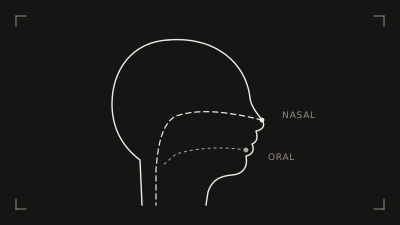
Does Mouth Breathing Change Your Face?
The link between breathing and face shape is one of the most repeated ideas in looksmaxxing, and the honest version is narrower, and more useful, than the one you have heard.
Skin & hair
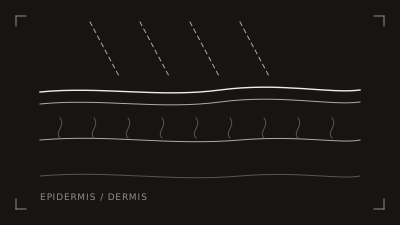
Skin Health and Your Face
One habit has a 4.5-year randomized trial behind it. Most of the rest of the skincare aisle does not.
Face structure
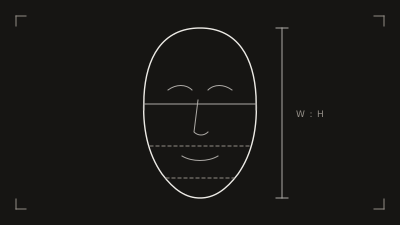
Body Fat and Your Face
Your jawline may already be there. The research says how much fat loss it takes before other people notice, and it is less than you might think.
This article is educational and about appearance. It summarizes published research and is not medical advice, a diagnosis or a treatment, and what a study found in its participants is not a promise about what GodModeLooks will do for you.